
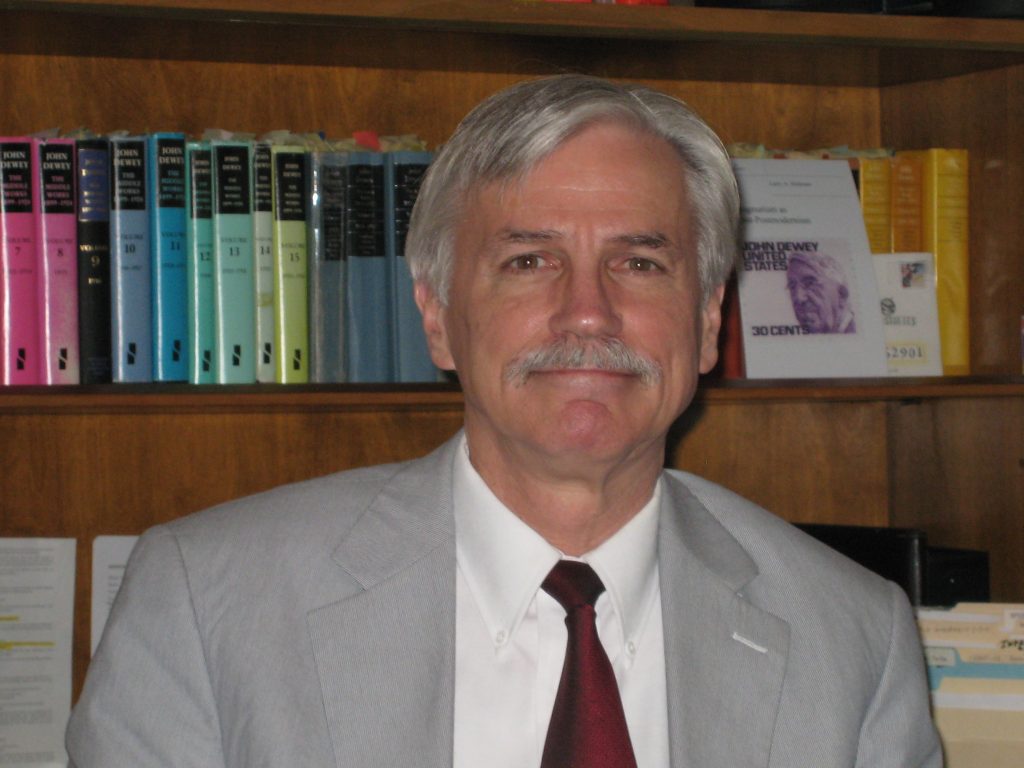
About Larry

Larry A. Hickman

Professor Emeritus, Department of Philosophy
Director Emeritus, Center for Dewey Studies
Southern Illinois University Carbondale

*Featured on the Official University of Oregon website*

“Larry A. Hickman is an internationally-recognized authority on the life and thought of philosopher John Dewey. His research explores the philosophy of technology, philosophy of education, environmental philosophy, American philosophy and pragmatism, critical theory, film studies, and the philosophy of religion.

“In 2015, a collection of Hickman’s essays, John Dewey Forever Young: Hickman on Dewey (ed. Wang Chengbing, China Legal Academic Press) was published. He also wrote and narrated the educational DVD, John Dewey: His Life and Work (2001), which is widely used in departments of philosophy and education, and received a CINE Golden Eagle Award in 2001. Hickman’s publications have been the recipients of three “Outstanding Academic Title” awards from Choice, and his work has been translated into a half-dozen languages.

“Prof. Hickman was a Phi Kappa Phi Scholar, and has served as president of the Southern Illinois University Carbondale chapter of Phi Kappa Phi. He has also served as president of several national and international societies, including the John Dewey Society, Society for the Advancement of American Philosophy, Society for Philosophy and Technology, and Southwestern Philosophical Society. He has served on numerous executive and advisory boards, including those of the Association for Documentary Editing, the International Pragmatism Society, the Dewey-Center Köln (Germany), and the Center for Studies of Dewey and American Philosophy at Fudan University (Shanghai, China). Internationally-known for his scholarship on themes such as technology, democracy, and education, Hickman has lectured in nineteen foreign countries.”

Seigfried – ‘Hickman is a phenomenon’

Charlene Haddock Seigfried, Purdue University

Larry  Hickman is a phenomenon. He  has done more than any person I know to make John Dewey and pragmatism known and appreciated throughout the world.  Two of his major  accomplishments are enough to demonstrate this, both of which span decades. Through his meticulous leadership at the Dewey Center at Southern Illinois University the critical editions of The Complete Works of John Dewey were painstakingly produced and widely lauded. Larry made the center not only a magnet for Dewey scholars, but an important venue for conferences, and a place for good companionship.  As if this were not enough, he established the Dewey Centers all over the world, which continue to be active hubs of scholarship.  They are a tremendous legacy and will ensure that pragmatist philosophy will continue to have an impact on important issues. I have many happy memories of good times with European scholars at some of these centers 

Larry has been a true friend and ever-supportive colleague.  He was one of the few persons who honored every aspect of my work, not only research and lectures on Dewey, but feminism at a time when it was (more) contentious, William James, and even technology. Whether we got together at Southern Illinois University, at conventions at home and abroad, on panels, or at SAAP, I always learned from Larry’s extensive philosophical interests. He was also fun to talk with and the best guide to outstanding restaurants and wine choices. In fact, I wouldn’t even have been at some of these events if Larry hadn’t made it happen. What I’m trying to say is that in a profession where women were often excluded, Larry always made me feel welcome and appreciated.  I am more than happy to return the favor and join many others who have been lucky enough to know you.

Pezzano – The Inclusive Model of School Based on Hickman’s Idea of Technological Culture

Teodora Pezzano

University of Calabria

Larry Hickman’s  work has been fundamental for Deweyan Scholarship and also for the idea of a new possible paradigm of a “technological culture.” In this paper I will try to  focus on the idea expressed in chapter 5, titled “Tecnoscience Education for a Life-long Curriculum, in  Hickman’s book Philosophical Tools for Technological Culture: Putting Pragmatism to Work (2001) applied to the contemporary problem of the school.

In particular Hickman’s idea of technological culture, inspired by Dewey’s Thought, is essential for the concept of an inclusive model of school, which is a development of democratic school theorized by Dewey during his university  experience in Chicago. In this perspective I will analyze Hickman’s idea of technological culture applied to education, the centrality of education in democratic theory of John Dewey, and the inclusive model of contemporary school which must be based on the humanistic culture and digital cultural.